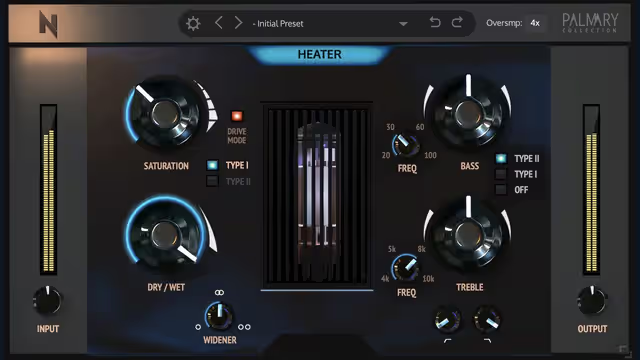

A stereo widener is the easiest plugin to abuse. Push it and the mix sounds huge on your desk, then collapses when someone plays it from a phone speaker. This walkthrough treats Spread Light as a widener of that family and gives you a repeatable way to use one without paying for it in mono. Exact controls differ between products, so match the steps to whatever knobs the interface actually shows.
The scenario: a thin pad that needs room
Take a single synth pad, a 4-bar chord loop, sitting at about -18 dBFS peak. It is narrow and slightly dull next to your drums. You want it wider without touching the kick, bass or lead vocal.
Step 1: pick the right target
Widen only sounds that are already stereo or that carry no low end. Never put a widener on:
- Kick, sub bass, or anything below roughly 120 Hz
- The lead vocal (a wide vocal loses its focus)
- The master bus as a first resort
Step 2: set a starting point
- Insert the widener on the pad channel, after any EQ.
- Start with the width control at about 120 to 130 percent if it is scaled that way, or a third of the way up if it is not.
- Insert a free correlation or mono-check meter after it, or simply flip your DAW's mono button.
- Loop the chord and toggle mono on and off. The pad should lose some airiness in mono but not drop in level by more than about 2 to 3 dB.
- If it vanishes, back off until it does not.
Step 3: protect the low end
If the plugin has no crossover, put a high-pass around 150 Hz on the pad before the widener. Low frequencies that are wide make phase problems and eat headroom. A quick way to hear it: solo the pad in mono and sweep the high-pass up until the boom stops flickering.
Widener types compared
| Method | How it widens | Mono risk | Best on |
|---|---|---|---|
| Mid/side gain | Turns the side signal up | Low | Pads, stereo loops |
| Short delay (Haas style) | Delays one channel by a few ms | High, comb filtering | Effects, quick tricks |
| Phase or all-pass smear | Shifts phase per band | Medium to high | Sparkle, atmospheres |
| Chorus doubling | Modulated copies, panned apart | Medium | Guitars, synths |
If the plugin never says how it works, test it: feed it a mono signal. A mid/side widener does nothing to true mono, while delay and phase types will suddenly create a stereo image.
A 5-minute A/B procedure
- Bounce 8 bars of the section with the widener off and bypass-matched in level.
- Listen on headphones, then on the smallest speaker you own.
- Switch the widener on and lower the output by whatever it added, so you are not just hearing "louder".
- Check in mono once.
- Keep the setting only if it wins on both the small speaker and in mono.
Troubleshooting
- Mix sounds hollow in mono: width is too high or a delay-based widener is comb filtering. Reduce, or switch to mid/side widening.
- Bass got weaker: you widened a source with low end. Filter first.
- Clicks when automating width: automate in smaller steps or smooth the curve.
- Everything feels far away: you widened too many tracks. Leave the centre elements dry so they anchor the mix.
Genre notes
In ambient and cinematic work, a wide pad behind a centred piano is the classic layout. In trap and drill, keep hats and one-shots mostly narrow and widen only the melody bed. For electronic dance music, widen the top layer of a supersaw stack and keep the core mono for club systems.
Setting up levels first
Widening changes perceived loudness, so keep your gain structure honest. Our gain staging guide covers how to keep headroom before effects. If you need to line up many free tools in one session, the free VST collection is a handy place to browse similar utilities. To place the widened pad in a space, a free reverb such as Valhalla Supermassive works well as a send.
Availability
Limited-time offers come and go. Before installing, confirm the current price and licence on the developer's official page and download only from there.
Widening a whole song section by section
Width is also arrangement. Give the verse a narrow, intimate picture and let the chorus open up. A simple plan: verse pad at 100 percent width (untouched), pre-chorus at about 115 percent, chorus at 130 percent. Automate the widener rather than switching it on and off, and the lift feels natural instead of like a trick.
Which sources deserve width
- Pads, string beds and ambient textures: yes, generously.
- Guitars doubled left and right: already wide, leave them alone.
- Percussion loops and shakers: a little, to make them float behind the drums.
- Reverb returns: sometimes, but check the result for phasey wash.
A phone-speaker sanity check
Export a 30-second bounce, send it to your phone and play it through the built-in speaker. Phones are effectively mono. If the pad you widened is still audible and the vocal is not fighting it, you are safe. If the section feels emptier than on your monitors, take 10 percent off the width and retest.
FAQ
How wide is too wide?
If the level drops by more than about 3 dB when you press mono, or an element disappears, it is too wide for real-world playback.
Can I use a widener on the master?
You can, gently, but fix the width on individual buses first. Master widening also widens the bass unless the tool has a low cut.
Why does my widened sound get quieter?
Side energy that cancels in mono lowers the summed level. That is the cost of width, so trade it off by ear.
Product and download reference
Spread Light Plugin: Free Limited-Time Offer Guide — reference at www.yum-audio.com. Check the destination for current versions, compatibility, licence, price and any registration requirements. A reachable page is not a guarantee that a past offer is still free.
Get Spread Light from Yum Audio