

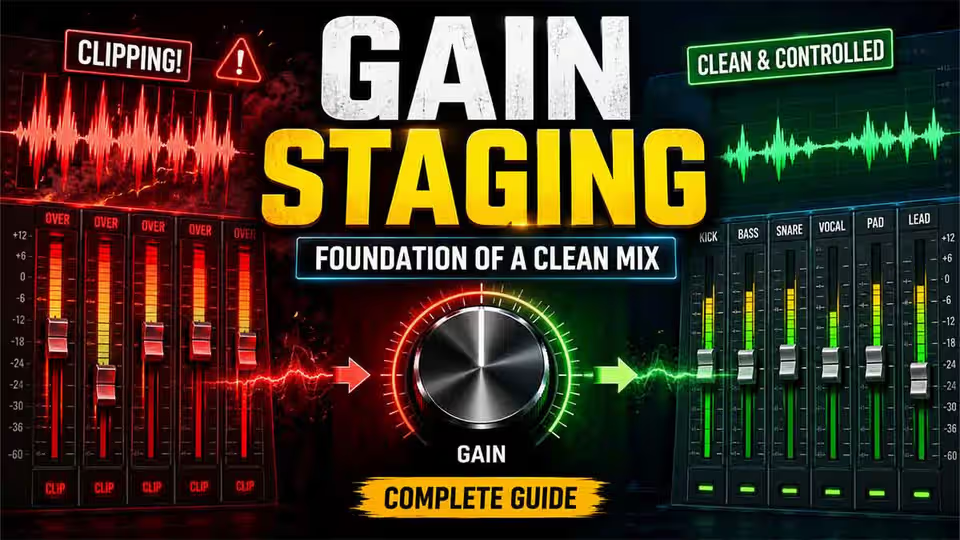
The Complete Guide to Gain Staging
Why signal level is the foundation of a clean, balanced and professional mix.
Every mixing engineer has a story about a session that sounded muddy, harsh, or oddly lifeless, only to discover the real problem wasn't a plugin choice or a bad EQ curve. It was gain staging.
Before compression, before EQ, before any creative decision, the level of your signal at each stage of the chain determines whether everything downstream behaves the way it's supposed to. Gain staging is not glamorous, but it is genuinely the foundation everything else sits on.
This guide breaks down what gain staging actually means, why it matters so much for digital audio workstations specifically, and how to build the habit into your workflow so it becomes automatic rather than an afterthought.
What Gain Staging Actually Means
Gain staging is the practice of managing signal level at every point in the audio path, from the moment a track is recorded or a sample is loaded, through every plugin in the chain, all the way to the master bus.
The goal is simple: keep each stage at a healthy level that avoids clipping while still giving you enough resolution and headroom to work with.
Too Low
The signal may require excessive boosting later and can make level management unnecessarily difficult.
Healthy Level
Strong enough for processing, but with enough headroom for transients, plugins and bus summing.
Too Hot
Plugins may saturate unexpectedly, transients can become harsh and the master bus can overload quickly.
In the analog world, gain staging was a matter of survival. Push a signal too hot into a piece of hardware and you'd get audible distortion immediately.
In the digital world, especially inside a DAW using floating-point audio engines, the consequences are subtler. You usually won't hear obvious distortion from an overly hot channel fader, but you will run into problems with how plugins react to input level, how much headroom you have for mixing decisions, and how your master bus behaves once dozens of tracks are summed together.
Why It's Called the “Foundation” of a Clean Mix
Think of a mix as a building. Gain staging is the foundation slab. If it's uneven, every wall built on top of it will be slightly off, and no amount of decoration will fix the structural problem.
Predictable plugins
Compressors, saturators and analog-modelled processors react more consistently.
More headroom
You have space for transients, bus processing and final mastering decisions.
Better decisions
Gain-matched comparisons help you judge tone instead of simply choosing the louder option.
Cleaner summing
Dozens of tracks can combine without immediately overloading the master bus.
Setting Levels at the Source
Gain staging starts before you even open a plugin. If you're recording audio, aim to capture a healthy signal that peaks comfortably below 0 dBFS, leaving room for transients you didn't anticipate.
Controlled peaks and natural dynamics
```Peaks remain safely below clipping, preserving the performance and leaving room for processing.
Flattened peaks and reduced headroom
Peaks hit the digital ceiling, increasing the risk of harsh distortion that cannot be repaired later.
Managing Level Through the Plugin Chain
Every processor has an input and an output. An EQ boost, compressor makeup gain, saturation plugin or limiter can increase the signal level before it reaches the next stage.
Good gain staging means checking the signal before and after each processor instead of allowing the level to increase gradually across the chain.
When bypassing a plugin, try to keep the processed and unprocessed versions at roughly the same perceived loudness. This prevents the common mistake of believing a setting sounds better simply because it is louder.
Building the Habit
Gain staging becomes second nature once you build a simple routine: check the source level, trim it to a consistent starting point with a clean gain plugin, monitor input levels into each processor, gain-match before making A/B judgments, and leave headroom on the master bus.
Leave headroom on the master bus
A healthy mix should not need to fight against the digital ceiling. Leaving space makes bus compression, limiting and mastering far easier to control.
Final Takeaway
```Gain staging is not about forcing every track to hit one exact number. It is about keeping the signal controlled, consistent and appropriate for every stage of the audio chain.
When your levels are managed properly, plugins behave more predictably, your master bus retains headroom and your mixing decisions become easier to trust. Build the habit early, and the rest of your mix will have a far stronger foundation.
```