
Multiband distortion has a reputation for sounding either magical or broken, and the difference is almost always in how you set the crossovers and how much you let each band do. This article is organised as a Q&A, because the questions people actually ask about Prisma and plugins like it are practical ones: where do I put the splits, why did my low end vanish, and how much is too much?
Why split the signal before distorting it?
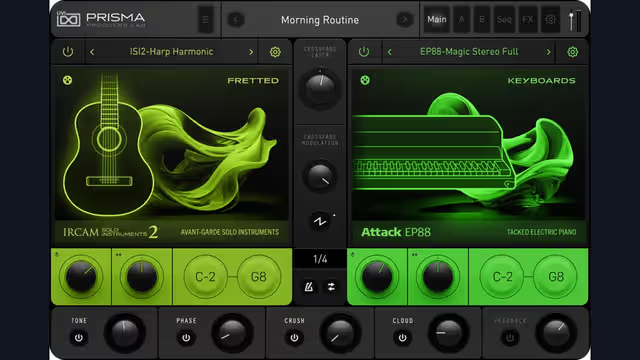
Distortion generates harmonics and intermodulation products. Feed a full mix through a single saturator and the bass frequencies modulate the highs, producing a muddy, fizzy result. Splitting into bands lets you drive the mids hard for aggression while leaving the sub clean. Prisma is described as a multiband distortion plugin, so that is exactly the job it targets. Check the developer's page for its exact band count and controls, as those details vary between products.
Where should I set the crossovers?
Start with a three-way split and adjust by ear:
| Source | Low / Mid split | Mid / High split | Note |
|---|---|---|---|
| Bass guitar or 808 | 120 Hz | 1.5 kHz | Keep low band nearly clean |
| Drum bus | 150 Hz | 4 kHz | Drive mids for snare crack |
| Synth pad | 250 Hz | 3 kHz | Drive highs lightly for air |
| Full mix (subtle) | 100 Hz | 5 kHz | Keep every band under 1 dB of change |
Walkthrough: turning a plain saw bass into a growl
- Play a single saw wave two octaves below middle C, around 65 Hz for C2.
- Insert the distortion and set the low split near 120 Hz, so the fundamental stays clean.
- Push the mid band drive until the tone bites, then reduce its output by a few dB.
- Give the high band a small amount of drive and cut everything above 10 kHz with an EQ afterwards to tame fizz.
- Automate the mid drive across an 8-bar phrase, low in bar 1 and high in bar 8, for movement.
Why did my low end disappear?
Two common causes. First, phase shifts from the crossover filters can cancel low frequencies when you blend dry and wet. If the plugin has a mix knob, try 70 percent wet or less. Second, harsh saturation on the lowest band flattens the waveform and reduces perceived punch. Keep that band clean or use a very gentle setting. Reference the guidance in our gain staging guide so the plugin sees a healthy input level, ideally peaks around -12 dBFS.
Level matching is the whole game
Distortion makes things louder, and louder always sounds better. Before judging, bypass and compare at identical loudness. Use the output trim to keep the average level within 0.5 dB of the dry signal. If you skip this step you will over-distort every session.
Use cases beyond bass
- Vocals: distort only the 2 to 6 kHz band at 5 to 10 percent mix for presence without harshness.
- Drum loops: parallel distortion on the mid band, blended under the dry loop.
- Sound design: automate the crossover frequency itself for sweeping textures.
- Guitars: clean the low band to tighten palm mutes.
Parallel setup for safety
Send the track to an aux, put the plugin there at 100 percent wet, and low-cut the aux at 100 Hz. Raise the return fader slowly until you sense the energy, then stop. This keeps the dry signal's transients intact and stops any single band from taking over.
Troubleshooting checklist
- Harsh hiss: reduce high-band drive or add a low-pass at 12 kHz.
- Pumping mid range: lower the input, since heavy drive can act like compression.
- CPU spikes: raise the buffer size or freeze the track when you are done.
- Clicks when automating: smooth the curve or automate in larger steps.
FAQ
Is multiband distortion good for mastering?
Only in tiny amounts, and generally on the upper mid or high band. Most masters do not need it.
How is it different from a saturation plugin?
A saturator treats the whole spectrum as one signal. A multiband tool lets each range get its own character. If you want a simpler option, see our note on a free saturation plugin.
Is Prisma still free?
Freebie status can change. Confirm price and availability on the developer's official page.
Looking for something to feed it? Browse the free VST collection for synths and samplers.
Ear-training exercise
Take one loop and apply distortion to only one band at a time, for one minute each. Write down what each band contributes: lows give weight, mids give aggression, highs give sizzle. Repeat with three different source sounds. After two sessions you will place crossovers by instinct instead of trial and error, and you will notice which recordings in your favourite tracks use band-limited distortion to sound big without getting harsh.
Worked example: widening a flat synth lead
Take a mono saw lead at 128 BPM. Split at 200 Hz and 4 kHz. Leave the low band untouched, give the mid band moderate drive, and add only a whisper of drive above 4 kHz. Follow with a stereo widener on the high band only. The lead gains edge and width while the low end stays centred and mono-safe. Bounce it, flip the master to mono, and confirm it does not thin out.
Product and download reference
Prisma: A Free Multiband Distortion Plugin — reference at vst.unplug.red. Check the destination for current versions, compatibility, licence, price and any registration requirements. A reachable page is not a guarantee that a past offer is still free.
Get Prisma from UnplugRed