

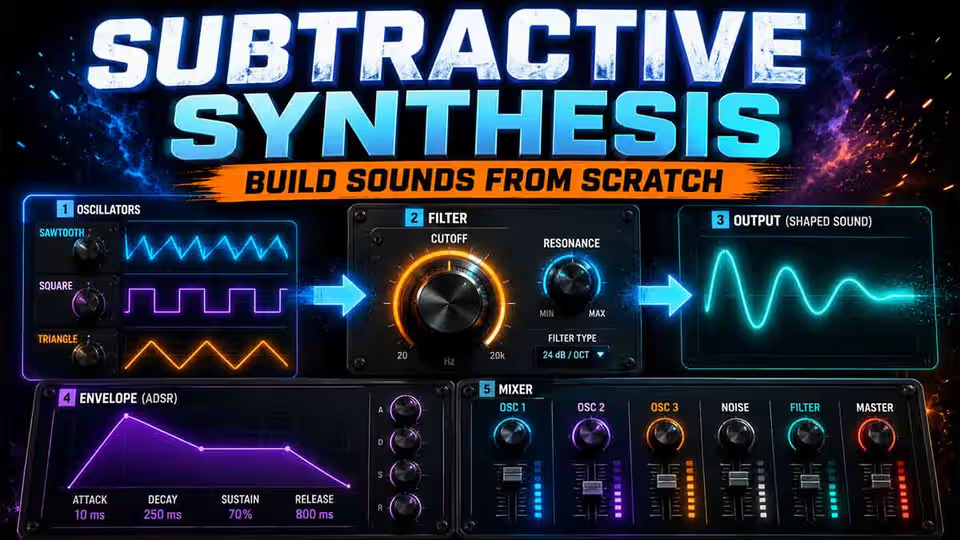
Subtractive Synthesis Explained Visually
Learn how oscillators, filters, amplifiers, envelopes and LFOs work together to build expressive sounds from scratch.
Every screaming lead, warm pad, and gritty bassline you've ever programmed on a synthesizer can be traced back to one foundational technique: subtractive synthesis. It's the oldest and most intuitive method of electronic sound creation, and it's the reason synths from the earliest modular systems to today's software instruments share the same basic building blocks.
The idea behind subtractive synthesis is refreshingly simple: start with a harmonically rich waveform and carve away the frequencies you don't want.
Subtractive synthesis in one sentence
Begin with a bright, harmonically complex signal, remove parts of its frequency spectrum with a filter, and then shape its volume and movement over time.
The Core Signal Flow
Nearly every subtractive synthesizer follows the same basic path: oscillator, then filter, then amplifier. This is often shortened to source-filter-amp.
Audio travels from left to right. Each stage changes a different property of the sound.
Oscillator
The oscillator produces the raw waveform that becomes the starting material for the patch.
Filter
The filter removes selected parts of the spectrum and gives the sound its tonal identity.
Amplifier / VCA
The amplifier determines how the sound enters, sustains and fades back into silence.
- Oscillator (source): Generates the raw waveform, the harmonically rich starting material.
- Filter: Removes or attenuates specific frequency ranges from that waveform, shaping its tone.
- Amplifier (VCA): Controls the volume of the signal over time, giving the sound its shape from silence to peak and back to silence.
Oscillators: Choosing Your Raw Material
The oscillator is where sound begins. Sine waves are pure with no harmonics, triangle waves add gentle odd harmonics, sawtooth waves are bright and rich with both even and odd harmonics, and square or pulse waves have a hollow, reedy character.
The shape of a waveform determines which harmonics are present before filtering begins.
Sine Wave
PureTriangle Wave
SoftSawtooth Wave
BrightSquare / Pulse Wave
HollowEach vertical bar represents the relative strength of a harmonic above the fundamental pitch.
Filters: The Heart of Subtractive Synthesis
A low-pass filter lets frequencies below the cutoff through while attenuating everything above it, and it's by far the most common filter type in subtractive synthesis. Resonance boosts the frequencies right at the cutoff point, adding character or, pushed far enough, causing the filter to self-oscillate.
Moving the cutoff changes brightness. Raising resonance emphasizes the frequencies surrounding the cutoff point.
High resonance can become a sound source. On filters capable of self-oscillation, extreme resonance produces a sine-like tone at the cutoff frequency, even when the oscillator level is turned down.
Envelopes and LFOs: Shaping Sound Over Time
Envelopes like ADSR—Attack, Decay, Sustain and Release—shape how a parameter changes over the life of a single note, while LFOs add continuous, repeating modulation for vibrato, tremolo and rhythmic filter movement.
Envelopes are triggered by notes. LFOs repeat continuously or in sync with the tempo.
ADSR Envelope
A one-shot shape that begins when a note is played and finishes after the note is released.
Low-Frequency Oscillator
A repeating modulation source that moves another parameter automatically.
| Modulation Source | Destination | Result | Typical Amount |
|---|---|---|---|
| Envelope 1 | Amplifier level | Controls the loudness shape of each note | 100% |
| Envelope 2 | Filter cutoff | Creates plucks, sweeps and evolving brightness | 30–80% |
| Sine LFO | Oscillator pitch | Produces smooth vibrato | 1–5% |
| Triangle LFO | Filter cutoff | Creates a steady repeating filter sweep | 10–50% |
| Velocity | Amplifier or filter | Makes the patch respond to playing strength | 10–40% |
Building a Sound From Scratch
A reliable way to understand subtractive synthesis is to build a patch in a fixed order. Begin with a single oscillator, shape its spectrum, control its amplitude, and only then introduce modulation and effects.
Following this order makes it easier to hear what each section contributes.
Warm Pad Slow & Wide
Pluck Short & Bright
Analog Bass Heavy & Controlled
Screaming Lead Bright & Animated
Conclusion
Subtractive synthesis rewards patience and a willingness to listen closely at each stage of the signal chain. Spend time with just an oscillator and a filter before you touch anything else, and you'll develop the kind of ear that makes every future patch faster to program and more musical to listen to.
The most important lesson is that complex sounds do not require complex starting points. A single rich waveform, a responsive filter and a carefully shaped envelope can already produce an enormous range of useful sounds.