


Composer Says AI Cost Him a Music Scoring Job — Is This the Future of Music?
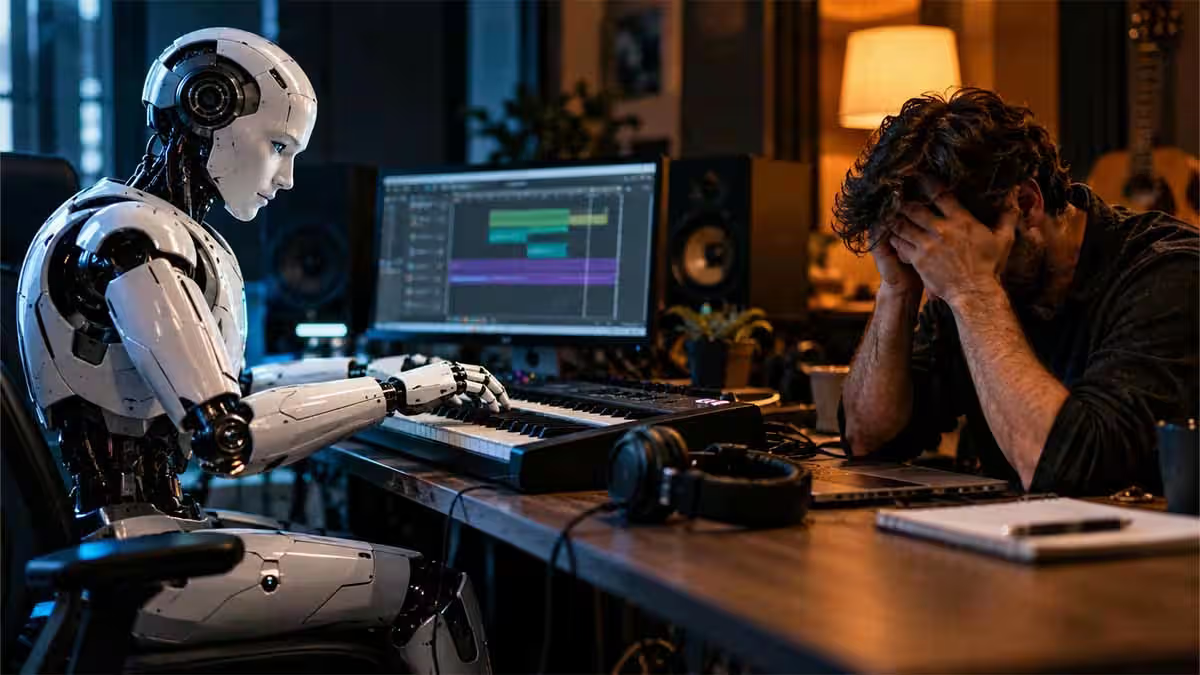
A recent Reddit discussion is highlighting one of the biggest fears facing professional musicians today: what happens when a client decides that AI-generated music is good enough to replace a paid composer?
A Composer Says a Web-Series Chose AI Instead
A discussion posted in the r/composer community on Reddit has attracted significant attention after a composer described losing a potential web-series scoring opportunity to artificial intelligence.
According to the composer's account, they had pitched for the project and received positive feedback about their turnaround time, production quality and ability to understand the feel of the show.
The job was never guaranteed. But the composer says they were later informed that the project's director or producer had decided to use AI-generated music instead.
The composer explained that the most frustrating part wasn't simply losing a job to another musician.
It was realizing that a production could potentially replace the traditional composer-client relationship with a prompt and an AI music generator.
It is important to note that this is the Reddit poster's personal account. The identity of the production was not established in the discussion, and the circumstances cannot independently be verified from the post alone.
However, the discussion touches on a much larger question that composers, producers, songwriters and recording artists are increasingly asking: could generative AI begin replacing some forms of paid music work?
Why This Story Matters to Music Producers
Artificial intelligence has been discussed in music production for years, but the conversation changes significantly when AI moves from being a creative tool to becoming a potential substitute for a paid musician.
For professional composers, production music has traditionally required a combination of skills that go far beyond simply generating a finished audio file.
Scoring to Picture
A composer may need to precisely match music to scenes, dialogue, transitions and emotional moments.
Client Revisions
Professional scoring frequently involves multiple rounds of specific creative revisions.
Musical Direction
Composers interpret references, characters, narrative arcs and sometimes very abstract feedback.
Production Control
Human producers can alter harmony, orchestration, tempo, arrangement and individual stems with precision.
Generative AI introduces a different proposition: describe the music you want, generate multiple versions and select one that appears to fit.
For some clients — particularly smaller projects with limited budgets — that convenience may be attractive.
The Biggest Threat May Be “Good Enough” Music
A major point raised by the Reddit discussion is that AI-generated music doesn't necessarily need to outperform professional composers in order to affect the marketplace.
It may only need to be considered good enough for a particular production.
A producer may compare commissioning an original score — including meetings, revisions, deadlines and payment — with generating music rapidly using an AI platform.
Even if the human-produced result is artistically stronger, some low-budget productions may prioritize speed and cost.
That difference is important because technological disruption often doesn't begin at the highest end of a profession.
It can begin with smaller projects where budgets are tight and clients have historically hired freelancers, emerging composers or production-music libraries.
Why Entry-Level Composers Could Feel the Pressure First
The early stages of a composer's career often involve projects such as:
- Independent short films
- YouTube productions
- Web series
- Student films
- Corporate videos
- Podcasts
- Advertising content
- Mobile games
- Online documentaries
- Small independent productions
These projects may not offer Hollywood-sized budgets, but they can be extremely important for building a portfolio.
If some of this work shifts toward automated music generation, new composers could potentially have fewer opportunities to gain professional experience.
That does not mean every low-budget production will choose AI. It does, however, explain why the Reddit discussion generated such an emotional response among musicians.
AI Music Still Has a Different Workflow
Several participants in the Reddit discussion argued that generating a finished track is very different from working with an experienced composer.
A director might say:
These kinds of detailed revisions have historically been an important part of the composer-director relationship.
AI music systems continue to improve, but the ability to create a complete piece of music does not automatically make the workflow identical to having editable multitrack sessions and direct collaboration with a composer.
AI Is Also Changing the Business Side of Music
The conversation goes beyond whether AI-generated music sounds good.
The music industry is currently dealing with broader questions about:
- How AI-generated music should be labeled
- Whether AI companies should license copyrighted recordings
- How musicians should be compensated when their work contributes to AI systems
- How AI-assisted songs should be registered
- Who owns different elements of AI-assisted productions
- How streaming services should treat large volumes of generated music
- How artists can track AI-related usage of their music
That means the debate is becoming less about “Can AI make music?” and more about “How does AI fit into the economics and rights infrastructure of the music industry?”
Will AI Completely Replace Human Composers?
No single Reddit post can answer that question, and current evidence does not justify claiming that composers as a profession are about to disappear.
Different parts of the market are likely to respond differently.
Some clients may prefer automated music
Projects where music functions primarily as inexpensive background material may find generative systems attractive.
Other productions may continue to value collaboration
Film, television, games and other media can require detailed musical storytelling, revisions, themes and communication between departments.
Some composers may incorporate AI into their own workflow
AI doesn't necessarily have to mean replacing the musician. Tools can also be used for experimentation, organization, sound design, idea generation or other supporting tasks while a human retains creative control.
The future may therefore contain several different models rather than one simple outcome.
A New Competition: Composer vs Composer vs Algorithm?
Traditionally, a freelance composer competing for a project might lose the job to another composer.
Now another possibility has entered the equation:
Human Composer
Custom composition, collaboration, revisions and creative interpretation.
Music Library
Pre-existing tracks licensed for film, video, advertising and other media.
AI Generation
Prompt-based generation offering rapid variations and potentially lower costs.
From the client's perspective, these can become three different solutions to the same question: “Where should the music for this project come from?”
What Human Composers Can Still Offer
Rather than attempting to compete with an algorithm purely on how quickly a piece of music can be generated, composers may increasingly need to emphasize the things that come from direct creative collaboration.
Could AI Actually Create More Music Work?
There is another side to the debate.
Technology that makes music creation cheaper could theoretically result in more projects using custom audio where they previously would have used no music or generic library tracks.
AI companies may also create new jobs involving music supervision, dataset management, rights management, attribution, prompt-based production, post-production and hybrid AI/human workflows.
Whether those opportunities offset work lost elsewhere remains an open economic question.
The effects will likely differ depending on the type of music work being performed.
AI Music Is Becoming an Industry Infrastructure Problem Too
As generative music becomes easier to create, the industry also faces a volume problem.
Large amounts of generated material can place additional pressure on music distribution systems, rights databases, royalty accounting and fraud detection.
That is why discussions around AI music increasingly include metadata, attribution and ownership rather than focusing exclusively on the quality of the generated songs.
For Young Producers, Adaptability May Matter More Than Fear
Music technology has changed repeatedly.
Affordable recording equipment disrupted expensive studio workflows. MIDI changed composition. Sampling transformed production. DAWs allowed a single producer to perform jobs that once required an entire studio.
Artificial intelligence could prove to be another major technological shift, although its effects on employment and copyright are still developing.
For aspiring composers and producers, that makes understanding both traditional production skills and emerging technology increasingly useful.
Knowing orchestration, harmony, sound design, mixing, storytelling and client communication remains valuable even as the tools surrounding those skills change.
The Reddit Discussion Shows the Emotional Side of AI
Statistics and industry reports can make technological disruption sound abstract.
This Reddit conversation attracted attention because it makes the issue feel personal.
For the composer involved, the question wasn't simply whether AI music is technically impressive.
It was the realization that a piece of professional creative work they hoped to perform might instead be completed through an automated system.
Other Reddit users responded with concerns about employment, copyright, creative quality and the future path available to younger composers.
The Reddit post represents an individual's account of what happened during one potential scoring job. It should not be interpreted as proof that the entire film or music industry is replacing composers with AI.
AI vs Human Musicians May Be the Wrong Question
The most useful question may eventually become:
For generic background music, automation may become increasingly competitive.
For projects built around distinctive musical identity, complex revisions, storytelling and collaboration, human composers may offer something quite different from simply generating an audio file.
The boundary between those two categories is likely to be one of the most important debates in music production over the coming years.
Frequently Asked Questions
Are composers losing jobs to AI?
There are individual reports of composers and other creative professionals losing opportunities where clients have chosen AI-generated content. However, isolated cases do not establish how widespread the effect is across the entire music industry.
Can AI replace a film composer?
AI systems can generate music, but professional film composition often includes scoring to picture, detailed revisions, thematic development, delivery specifications and close collaboration with directors.
Why would a producer use AI-generated music?
Possible reasons include speed, cost, convenience and the ability to rapidly generate multiple musical ideas. Different productions will weigh those advantages differently.
Will AI replace music producers?
The long-term employment impact is uncertain. AI may automate some tasks, change existing roles and create new workflows while other areas continue to depend heavily on human creative direction.
Is AI-generated music legal?
There is no single global answer. Copyright, licensing and ownership rules vary by jurisdiction and are continuing to develop as AI technology evolves.
Should musicians learn AI tools?
Understanding emerging technology can be useful, but musicians can also benefit from strengthening skills that remain important regardless of the tools being used, including composition, production, performance, storytelling and collaboration.
Final Thoughts
The Reddit composer's story offers a small but revealing glimpse into a much larger transformation taking place across the creative industries.
For decades, technology mainly changed how musicians made music.
Generative AI raises a more uncomfortable possibility: technology may increasingly influence whether a human musician is hired in the first place.
That doesn't mean human composition is disappearing. But it does mean composers, producers, artists and the companies hiring them are beginning to reconsider what human creative work is worth in a world where music can also be generated from a prompt.
The answer is still being written — by musicians, technology companies, rights holders, audiences and the people deciding what kind of creativity they want to support.