

FM Synthesis for Beginners: Crafting Bells, Basses, and Beyond
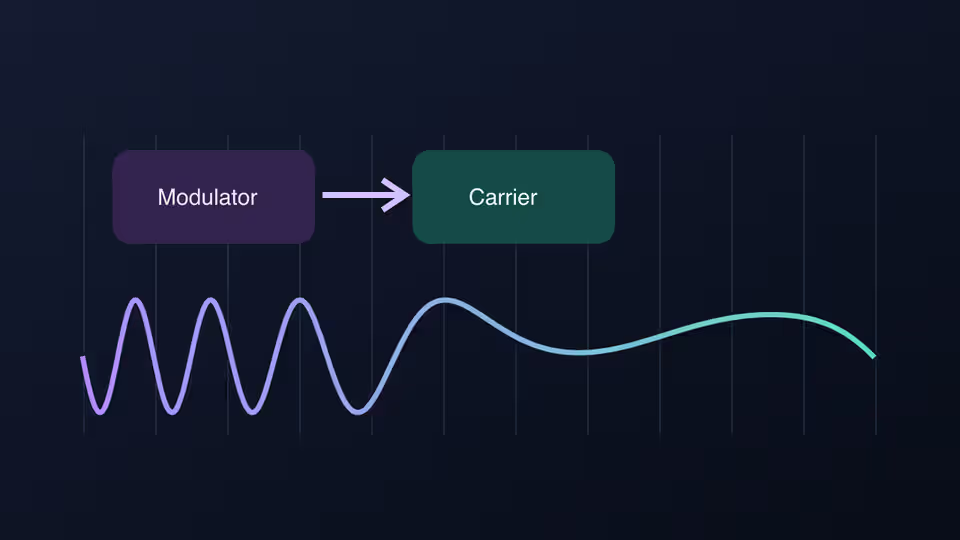
If subtractive synthesis involves sculpting a sound from something rich and complex, FM synthesis is about building complexity starting from something almost absurdly simple. Two basic sine waves, interacting in the right way, can generate sounds ranging from metallic bells and punchy electric pianos to incisive basses and otherworldly textures.
What exactly is FM synthesis?
FM stands for frequency modulation. Two oscillators are used: a carrier (the sound you actually hear) and a modulator, configured to modulate the carrier's frequency. When the modulator operates at a sufficient speed, it generates new frequencies around the carrier's pitch, known as sidebands.
The Ratio: Harmonic vs. Inharmonic Tones
The relationship between the carrier and modulator frequencies determines whether the sidebands fall on integer multiples of the carrier (harmonic, musical) or at intermediate values (inharmonic, bell-like, or metallic).
Simple integer ratios (1:1, 2:1) produce harmonically related sidebands with musical pitch, ideal for bass and "pluck" sounds.
Non-integer ratios (e.g., 1:1.4) shift the sidebands away from the harmonic series, creating metallic or bell-like tones.
Modulation Index: Controlling Intensity
The modulation index controls how strongly the modulator affects the carrier. A low index produces a soft, subdued timbre; increasing it adds more sidebands, making the tone brighter and more complex (this is the FM equivalent of a filter cutoff frequency).
Operators and Algorithms
True FM synthesizers use multiple operators organized into algorithms: in a chain (one modulates the next), in parallel (mixed together), or with feedback (an operator modulates itself, adding warmth at low levels and noisy chaos if pushed to the extreme). Practical applications: Where does FM synthesis excel?
Bells and metallic percussion: non-integer ratios with a fast-decay envelope.
Electric piano tones: moderate modulation index with a fast-decay envelope applied to that index.
Bass sounds: low modulation index with simple integer ratios to achieve a punchy attack and a sharp initial transient ("clicky" sound).
Evolving pads: slow modulation of the index or ratio over time to create constantly changing harmonic content.
Conclusion
FM synthesis rewards curiosity more than memorization. Isolate one parameter at a time—a change in the ratio, a sweep of the modulation index—and simply listen. Once you internalize how the ratio controls harmonic character and the index regulates brightness, FM synthesis stops seeming like an obstacle and becomes a truly deep, expressive palette.
Featured image
Original FM synthesis diagram showing a modulator feeding a carrier and a resulting complex waveform. Original illustration: Deadloops.