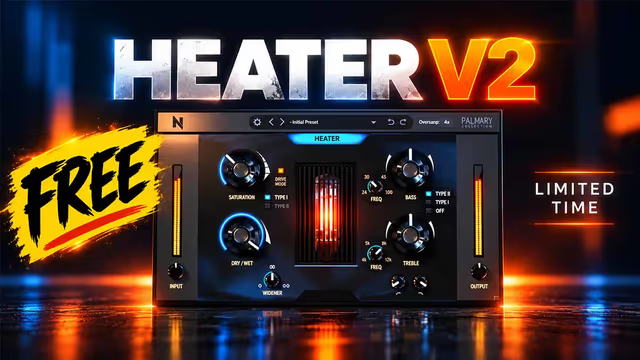


Audio Singularity is a developer that has released amp simulation plugins, including free ones, so producers frequently search for its latest giveaway. This guide focuses on what matters regardless of which amp sim you load: interface setup, signal chain, cabinet impulse responses and mixing. Follow it and free tools can sound impressively professional.
Check first: confirm the current version, license and price on the developer's official website before downloading. Promotions can end.
What is an amp sim?
An amp simulator is software that models a guitar amplifier, and often the pedals and speaker cabinet too. You record the guitar direct through an audio interface, which gives a clean, unprocessed signal, and the plugin turns it into a tone you can change at any time.
Set up your signal path
- Plug the guitar into a high-impedance instrument input on your interface.
- Set the input gain so peaks stay well below clipping, around -12 dBFS on the meter.
- Use a low buffer size, such as 64 or 128 samples, while recording to keep latency small.
- Insert the amp sim on the track and turn on input monitoring.
- Raise the buffer size when mixing to free CPU.
A good, clean recording matters more than the amp model. If you are unsure about levels, read our guide to gain staging.
The chain inside the plugin
| Stage | Role |
|---|---|
| Noise gate | Cuts hiss between notes, especially for high gain tones. |
| Overdrive pedal | Tightens low end and pushes the amp harder. |
| Amp head | Provides preamp gain and tone shaping. |
| Cabinet or IR | Shapes the speaker sound. A poor cab makes any amp sound fizzy. |
| Post effects | EQ, delay and reverb. |
Dial in a clean tone
Set gain low, treble around the middle, bass and mids to taste, and presence sparingly. A clean tone should not clip on strong strums. Add a light compressor for evenness, and a touch of spring or plate reverb for depth. Check the mix on speakers, because clean guitars often feel bright on headphones.
Dial in a high-gain tone
Use an overdrive in front with drive low and level high to tighten the low end. Increase amp gain until notes sustain but chords remain defined; more gain is not always better. Roll off harsh fizz above 6 to 8 kHz and cut boxy content around 400 Hz if it clouds the mix. Double-track and pan left and right for a wide rhythm sound.
Cabinet impulse responses
If your amp sim allows loading third-party IRs, experiment. Small changes in mic position and speaker type shift the tone dramatically. Use IRs from sources that clearly state their license.
Mixing the guitar
- High-pass around 80 to 100 Hz to leave space for bass and kick.
- Low-pass around 8 to 10 kHz to remove fizz.
- Cut a little in the mids if the vocal struggles.
- Use a compressor gently; the amp already compresses.
See our compressor guide for setting attack and release, and the free VST list for cabinet loaders, EQs and reverbs.
Free amp sim tips that save time
Start with the preset closest to your target style and adjust from there instead of building from zero. Save your own versions once you find a tone you like. Keep an A/B comparison between the amp with and without your pedal so you know it is helping. Avoid using gain as a substitute for good playing; a tight performance on a moderate gain amp often sounds bigger than sloppy playing on maximum gain.
Bass and acoustic instruments
Amp sims are not only for guitar. Bass through a mild overdrive and a bass cabinet gains grit that cuts through small speakers. Synths can also be pushed through an amp for character, which is a classic trick for adding aggression to leads. Try re-amp style processing on drums and vocals too, blended in parallel to keep the original clarity.
Save presets and screenshots of your settings as you go. When a tone works in a mix, note the amp, cab and gain positions so you can recreate it in the next project.
Key takeaways
- Record a clean direct signal and process it afterward.
- Keep latency low while tracking.
- The cabinet or IR has as much impact as the amp.
- Tighten high gain tones with a pedal and gate.
- Download only from the official developer page.
FAQ
Is Audio Singularity's amp sim really free?
Some releases have been. Check the developer's page to confirm the current status.
Do I need an audio interface?
It is strongly recommended for low latency and a clean guitar input.
Why does my amp sim sound fizzy?
Usually excess gain or a harsh cab. Lower gain and low-pass the top end.
Can I use my own cab IRs?
If the plugin has an IR loader, yes. Otherwise use a separate IR plugin.
Get Neurontube Debut from Audiosingularity